

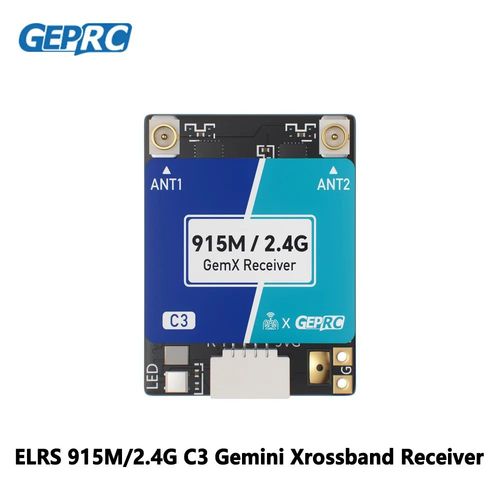
GEPRC ELRS 915M/2.4G C3 Gemini Xrossband Receiver
Product Overview
The GEPRC ELRS 915M/2.4G C3 Gemini Xrossband Receiver is a dual-band ExpressLRS control-link receiver designed for FPV aircraft requiring flexible frequency selection, high packet rates and redundant RF links. It combines an ESP32-C3 processor with two Semtech LR1121 RF chips and supports 915MHz Gemini, 2.4GHz Gemini and simultaneous 915MHz plus 2.4GHz operating modes.
Technical Highlights
Three Selectable RF Modes
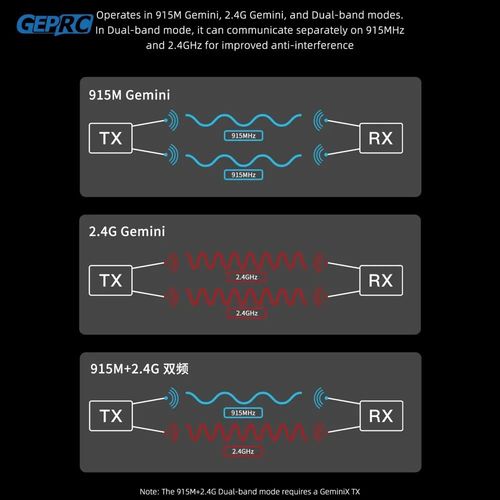
Select 915MHz Gemini, 2.4GHz Gemini or 915MHz plus 2.4GHz dual-band operation according to the transmitter system and local RF requirements. Simultaneous dual-band operation requires a compatible Gemini Xrossband transmitter.
Dual LR1121 RF Architecture
Two Semtech LR1121 RF chips provide independent radio paths for Gemini reception. The architecture supports both sub-GHz and 2.4GHz operation, helping maintain a reliable control link in changing RF environments.
Up to 1000Hz Refresh Rate
LoRa and FSK operating modes support refresh rates from 25Hz to 1000Hz, allowing the receiver to be configured for different combinations of latency, range and RF robustness.
100mW Telemetry and MAVLink Support
Telemetry power is rated up to 100mW. Bidirectional MAVLink v2 support enables combined remote-control and data-transmission applications when used with compatible flight-control and ground-station equipment.
TCXO and Wi-Fi Firmware Updating
A temperature-compensated crystal oscillator improves frequency stability, while integrated Wi-Fi allows supported firmware updates without requiring a separate programming adapter.
Technical Specifications
| Product Name | GEPRC ELRS 915M/2.4G C3 Gemini Xrossband Receiver |
|---|---|
| Product Type | Dual-Band ExpressLRS Gemini Control-Link Receiver |
| Main Processor | ESP32-C3 |
| RF Chip | 2 × Semtech LR1121 |
| Operating Modes | 915MHz Gemini, 2.4GHz Gemini, or 915MHz + 2.4GHz Dual Band |
| Refresh Rate | 25Hz–1000Hz, LoRa and FSK |
| Telemetry Power | Up to 100mW |
| Input Voltage | 5V DC |
| Serial Output Protocols | CRSF, SBUS, SUMD, DJI RS2 Pro and MAVLink |
| Frequency Reference | TCXO |
| Antenna Interface | IPEX1 |
| Receiver Connector | SH1.0 4-Pin |
| Firmware Target | GEPRC C3 900/2400 Gemini Xrossband RX |
| Firmware Update | Wi-Fi Supported |
| Status Indicator | RGB LED |
| Dimensions | 18 × 23.6 × 5.7mm |
| Weight | 1.6g, Receiver Only |
Operating Mode and Antenna Configuration
| Operating Mode | Recommended Antenna Configuration |
|---|---|
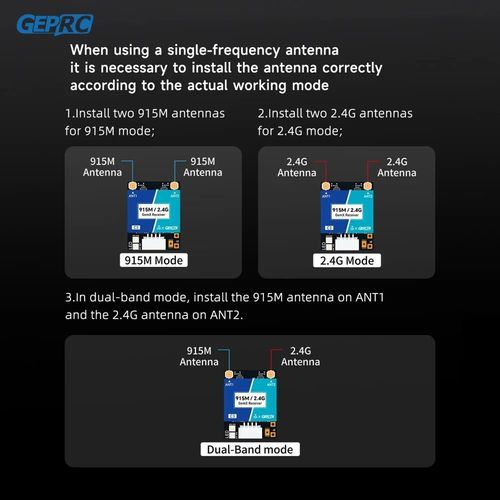
| 915MHz Gemini | Connect two suitable 915MHz antennas. |
| 2.4GHz Gemini | Connect two suitable 2.4GHz antennas. |
| 915MHz + 2.4GHz Dual Band | Connect the 915MHz antenna to ANT1 and the 2.4GHz antenna to ANT2. |
| Included Dual-Band Antennas | The supplied 915MHz/2.4GHz dual-band T-antennas can remain installed when switching between supported operating modes. |
Flight Controller Connection
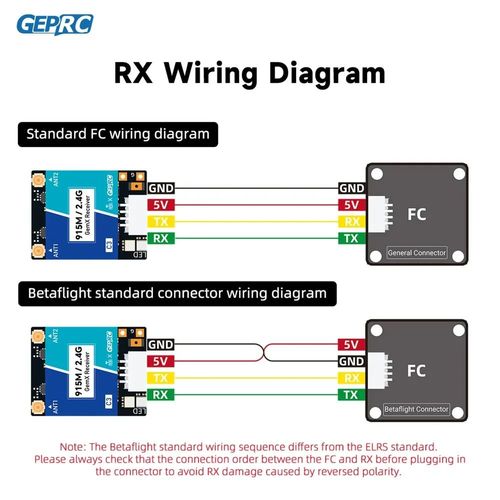
Connect receiver GND to flight-controller GND.
Connect receiver 5V to a regulated 5V output.
Connect receiver TX to a flight-controller RX pad.
Connect receiver RX to a flight-controller TX pad.
Select the required serial protocol and UART in the flight-controller configuration.
Power off the system before connecting or disconnecting the receiver.
Verify the connector pin order before applying power, as cable polarity may vary between flight controllers.
Optional RX-as-TX Operation
The receiver can be configured for transmitter operation by selecting the RX_AS_TX option and flashing the applicable TX firmware. The supplied documentation specifies firmware version 3.6 for ESP32-C3 TX conversion. A compatible custom JR bay modification kit is also required. In this configuration, output power is up to 100mW. The JR bay conversion kit is not part of the standard receiver package unless separately confirmed.
Package Contents
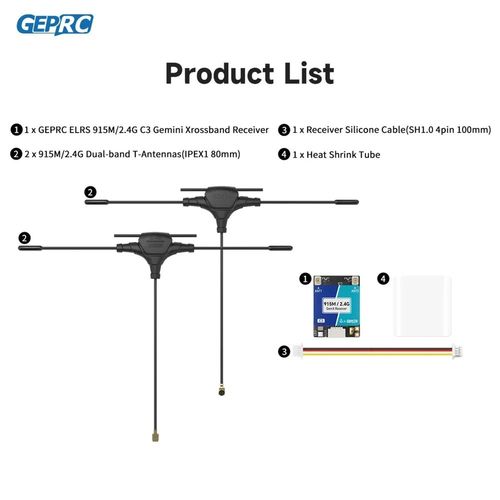
1 × GEPRC C3 Gemini Xrossband Receiver
2 × 915MHz/2.4GHz Dual-Band T-Antennas, IPEX1, 80mm
1 × SH1.0 4-Pin Receiver Silicone Cable, 100mm
1 × Heat-Shrink Tube
1 × User Manual
Important Notes
This product is an ExpressLRS control-link receiver, not a video transmitter.
Simultaneous 915MHz and 2.4GHz operation requires a compatible Gemini Xrossband transmitter.
Single-band operation can be used with a compatible ExpressLRS transmitter for the selected frequency.
Always install suitable antennas before powering RF equipment.
Confirm that the selected frequency is permitted in the destination country or region.
Specifications and package contents should be confirmed for volume orders before production.
FAQ
Is this product a video transmitter?
No. It is an ExpressLRS control-link receiver for receiving RC commands and returning telemetry data. It does not transmit FPV camera video.
Which frequency modes does the receiver support?
It supports 915MHz Gemini, 2.4GHz Gemini and simultaneous 915MHz plus 2.4GHz dual-band operating modes.
Do I need a dual-band transmitter?
A compatible Gemini Xrossband transmitter is required for simultaneous 915MHz and 2.4GHz operation. The receiver can also work in a corresponding single-band mode with a compatible ExpressLRS transmitter.
What does the 100mW rating mean?
In standard receiver operation, the rating refers to telemetry output power of up to 100mW. When correctly converted for RX_AS_TX operation, the receiver can also provide up to 100mW transmitter output.
What packet or refresh rates are supported?
The receiver supports refresh rates from 25Hz to 1000Hz across applicable LoRa and FSK modes. Available settings also depend on the transmitter and installed ExpressLRS firmware.
Which serial protocols are supported?
Supported serial outputs include CRSF, SBUS, SUMD, DJI RS2 Pro and MAVLink. The selected protocol must also be supported and correctly configured on the connected controller.
How should the antennas be installed?
For dedicated 915MHz operation, use two suitable 915MHz antennas. For dedicated 2.4GHz operation, use two suitable 2.4GHz antennas. In dual-band mode, connect the 915MHz antenna to ANT1 and the 2.4GHz antenna to ANT2. The included dual-band T-antennas support both bands.
Can the receiver firmware be updated wirelessly?
Yes. The ESP32-C3 platform supports Wi-Fi firmware updating when used with a compatible ExpressLRS firmware package.
Can this receiver be converted into a TX module?
Yes, but it is an advanced modification rather than the standard product configuration. The RX_AS_TX option, applicable TX firmware and a custom JR bay modification kit are required. The supplied documentation specifies firmware version 3.6 for ESP32-C3 TX conversion.
B2B Procurement FAQ
What is included in the standard package?
The standard package includes one receiver, two 80mm IPEX1 dual-band T-antennas, one 100mm SH1.0 4-pin silicone cable, one heat-shrink tube and one user manual. Package contents should be reconfirmed before a volume order.
Is the JR bay conversion kit included?
No. The custom JR bay modification kit required for RX_AS_TX operation is not included in the standard receiver package unless it is separately listed and confirmed in the quotation.
Can samples be ordered before a volume purchase?
Sample availability, lead time and sample pricing can be confirmed before placing a production order. Functional evaluation should include the intended transmitter, firmware, flight controller and antenna setup.
Can firmware and operating modes be specified for bulk orders?
Firmware version, target configuration and preferred operating mode can be documented in the purchase specification. Any firmware preloading or configuration service is subject to quantity and written confirmation.
Are custom packaging and cable options available?
Custom labels, packaging, cable lengths and accessory combinations may be available subject to minimum order quantity, technical review and written confirmation before production.
What should buyers confirm for regional compliance?
Buyers should confirm whether 915MHz and 2.4GHz operation, the selected output power and the intended antenna configuration comply with local radio regulations in the destination market.
What information is required for a quotation?
Please provide the required quantity, destination country, operating frequency, firmware requirements, antenna configuration, packaging requirements and requested delivery schedule.
Leave Your Message
Products categories
-
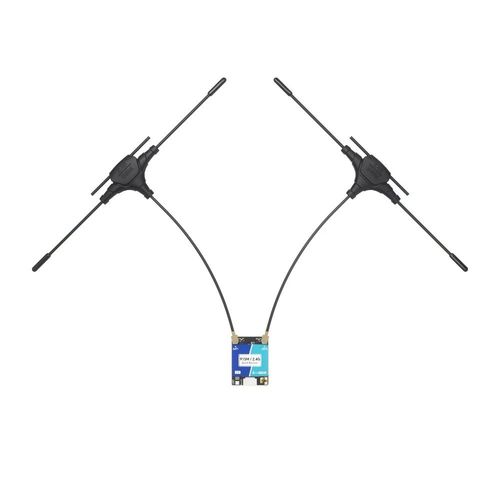
GEPRC ELRS 915M/2.4G C3 Gemini Xrossband
-
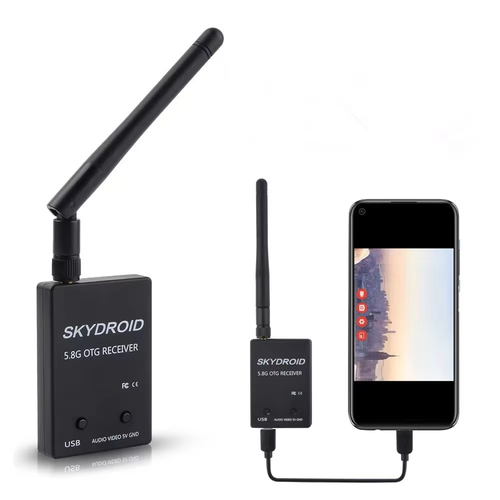
SKYDROID 5.8G 150CH UVC OTG FPV Receiver
-
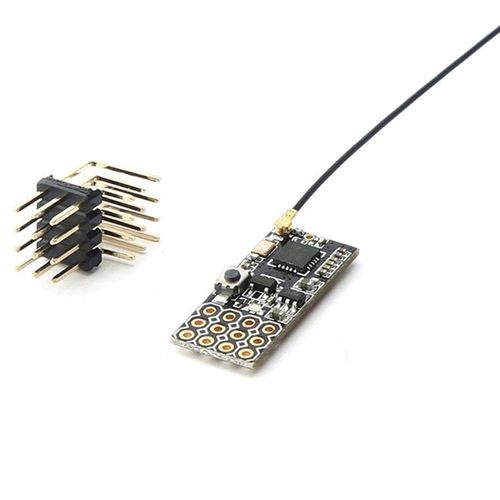
FS2A Mini 4CH AFHDS 2A PWM Receiver
-
TBS Crossfire Nano RX
-
1.2GHz 1500mW Wireless AV Transmitter an
-
Foxeer ELRS 915/868MHz Receiver
-
GEPRC ELRS Nano 915M PA500 Receiver
-
Flysky FGr4 / FGr4S / FGr4P AFHDS 3 Rece
-
CYCLONE ELRS 2400RX-7CH V1.1 Receiver
-
DAKEFPV Ultra1600 / Ultra2500 64CH Analo